Hi all. In this post, I will be going through my thought process when given the live brief and explaining my journey from start to end. Firstly, I will be discussing research and various concepts I developed until inevitably finding the process that led to the final outcome that I produced.
Types of Lighting – Research
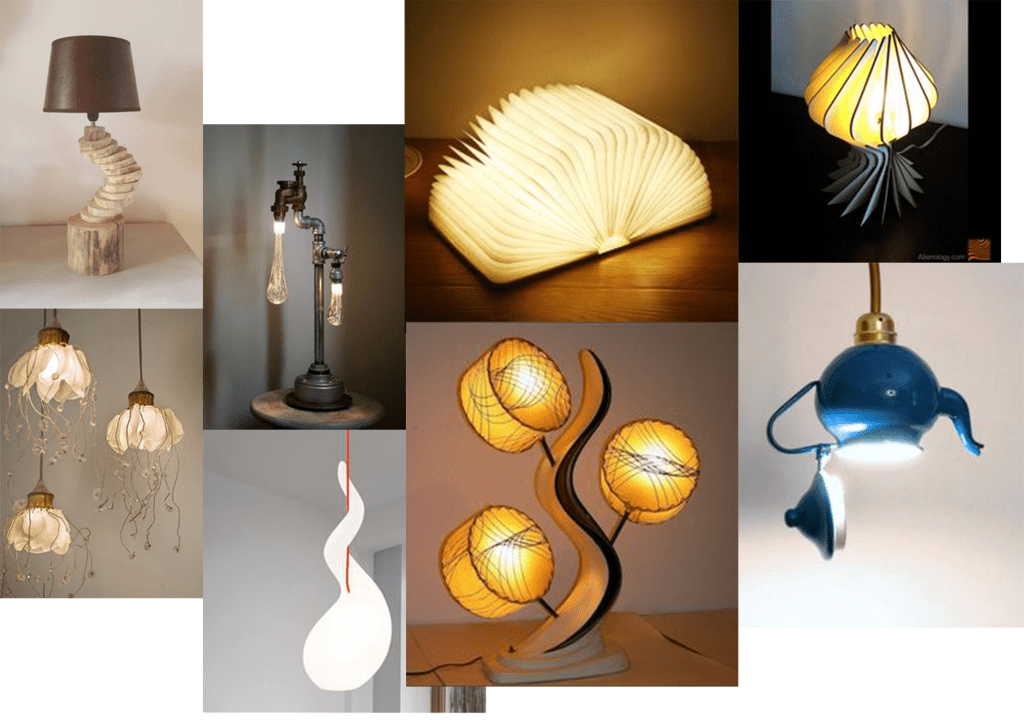
When I was first given the range of live briefs, the lighting brief just stuck out more to me than the others. As soon as I received it, my mind jumped into brainstorming mode and looked into what kind of light fixtures I could make. I knew I wanted to create something with irregular form and curious shapes, something that was unique and strange but still looked like a complete decorative piece. With this mindset, I found myself drawn to curved shapes, repetitive spirals and the reuse of other objects to create a whole new item.
My Pinterest board containing all of the types of lighting I found interesting can be found here:
Types of Lighting – Artist Research
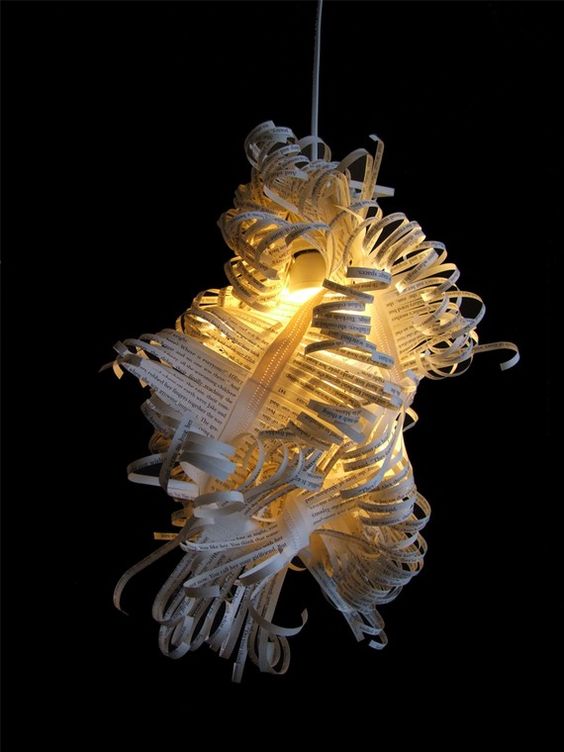
After becoming fascinated with spirals and chaotic forms of obscure shapes, I looked for lighting pieces made by artists that I could draw influence from when I started my journey of discovering what I would want to create. Through my research, I found several artists who had pieces that stuck out to me. A list of some examples is as follows;
- Emile Gallé – French Art Nouveau Glassmaker (Mushroom Lamp)
- François-Xavier Lalanne – French Sculptor & Installation Artist (Pigeon)
- Studio Gingko – Unknown (The Curl Lamp)
- L Wendy Dunder – American Illumination Sculptor (Morning Flight)
- Albert Jaun i Torner – Spanish Modernist Architect (Trafalgar 014h)
- Allyson Clark – American Artist (Little Wing Faerie Art)
- Kinzig Design – American Designers (Sam)
- Floral Fawna – Homeware Store (Gothic Crow Lamp)
- Studio Job – European Craftsman (Banana Lamps)
- William Francis – Unknown (Golden Goose)
- 7Gods – British Lighting Design Crafters (Table Lamp)
- Cameron Mathieson – Canadian Designer (Lightness)
- Chantelle – Unique Bespoke Lighting
- Karman – Creative Group (Sibilla)
- Brand Van Egmond – Designer Collective (The Nightwatch Collection)
- Moe’s Home Collection (Swan Pendant Lamp)
- Tom Raffield – British Designer Maker (Skipper)
- Freshwest – Welsh Design Studio (Cubist Lamp 01)
- Alexander Calder – American Sculptor (Primary Motions)
- Stuart Haygarth – British Artist (Tide)
- Ingo Maurer – Lighting Designer (Zettel Light)
- James Turrell – American Light Artist (Roden Crater)
A full roster of all the works I looked into from the artists stated above, as well as a few other examples can be found here:


Brainstorming Ideas – Mind Map
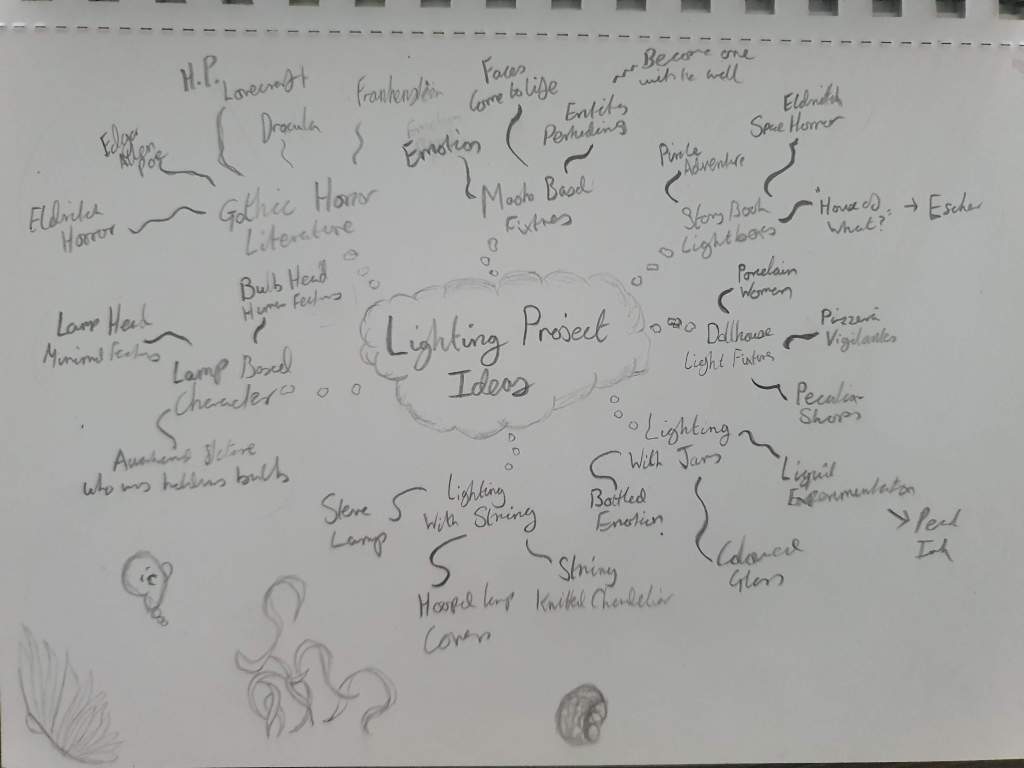
After conducting research into different types of lighting and light-based artisans, I decided to put all my ideas onto paper to be able to see all the potential avenues I could take. Most of the time, I can narrow down my ideas and concepts until I find one to stick to. However, with this project, I wanted to develop all the concepts I could on paper beforehand to give me a better idea of what forms they could take.
The process of all of my concepts will be discussed further but a list of the ideas broken down to their initial notes is as follows;
- Gothic Horror Lighting
- Pull from concepts of either Media Horror or Horror Based Literature
- Examples Include:
- Classic Gothic Horror
- Frankenstein Arm Lamp
- Veins pump reactive light – lightning-powered being
- Switch to look like an old lightswitch handle (Lever)
- Place Daisy reference somewhere, a possible tattoo?
- Dracula’s Heart
- Breathing red light as it pumps
- When in contact with a Stake, Light emanates a roaring fire as if it is disintegrating
- Frankenstein Arm Lamp
- Eldritch Horror – H.P. Lovecraft
- Chandelier
- Portal shape acts as the pendant – Allows for Ambient Light
- Tendrils extend and overlap each other, creating a chaotic sense of uncertainty
- Lights are either globules that the tendrils hold or a part of the tendrils
- Wall Fixture
- Portal shape attaches to wall – Ominous background light
- Tendril look like they are escaping the portal
- Lights are positioned in the same way as the chandelier (Held Globules or Incorporated Tendril Light)
- Chandelier
- Edgar Allen Poe
- Influential Pieces:
- The Fall of the House of Usher – Split house, Half sunken into a glowing lake
- The Raven – Nevermore themed bird style lamp with a vivid purple colour palette
- Influential Pieces:
- Classic Gothic Horror
- Possible Processes/Materials
- Repurpose Mannequin Limbs or Make your own limbs out of Latex?
- Cast Tendrils either out of Clay or Resin
- Foam/Paper/Cardboard to recreate buildings
Mask Based Light Fixtures
- Use either Mask Designs or Well Known Masks to create lighting effects
- These will work like pulleys/secret blended buttons to allow the facade to remain the same
- Examples Include:
- Emotion Approach
- Emotion Masks that shift and change lighting colour depending on how you are feeling (Play on of “Mood Lighting”)
- Minimalistic Approach = Use of light and shape to convey how you feel? (James Turrell)
- Haunted Mansion-type masks that when lit act as ghosts
- Fun Interactive head that moves and talks – Incorporate Alexa?
- A Still Portrait that when turned on shows a projection of the ghost of the person – Moving Portrait?
- Demonic Entity trying to enter?
- Nightmare on Elm Street face protruding through a wall?
- Jekyll and Hyde situation?
- Emotion Approach
- Possible Processes/Materials
- Wood/Ceramic Components to combine together (Possible 3D Printing?)
- Projector combination with masks to create illusion?
- Stretching spandex over a prebuilt structure to create an illusion
- Lightbox Story Ideas
- Lights that look like books when closed but reveal a story when open
- These stories can be ones I have written or based on popular literature
- Examples Include:
- Sea Born Pirate Adventure? – Lighting can look like flowing waves
- Can Pull from Classic Seaborn Tales – Moby Dick, Pirates of the Caribbean, Treasure Island
- Can base it off of own story – Title TBD
- Eldritch Space Horror – Lighting to look like a full starscape with the occasional shift and blinking eyes
- Can pull from The Colour of Space? – Vivid Pink/Purple colour palette that swarms and takes over
- Can base it off of own story – Title TBD
- “House of What?” Illusion Lightscape – Escher style lightscape to showcase changing and infinite
- Light in the form of a storybook
- Light that originates as a puzzle box, shifts and moves the more you solve it?
- Sea Born Pirate Adventure? – Lighting can look like flowing waves
- Possible Processes/Materials
- Creating a box from cardboard and binding a cover to it (Chest to look like a book)
- Breathing/Spectrum Lighting to allow for effects
- Circuit tracks to allow for moving components?
- Lights that look like books when closed but reveal a story when open
- Dollhouse Light Fixtures?
- The lamp is designed as a house that is openable and contains a narrative based on the house
- This can be who resides here, what they are like and what happens daily?
- Examples Include
- Porcelain Womans’ Mansion – Gothic Horror style manor tiered in levels showing the dark secrets within
- Influences from The Castle of Otranto (Horace Walpole, 1764)
- Includes strange passageways and an abandoned feel
- Ominous Woman watches from the window
- Pizzeria Vigilantes – Metropolitan Pizza Shop with a secret lair hidden
- Two layered Pieces inside but the facade only shows one layer
- Top = Classic style pizza shop, retro seating and strange inspiration posters
- Bottom = Rather than a dingy secret lair, it is also pizza-themed
- Peculiar Shops – Fantasy style shop filled with bizarre inventory
- Shelves are stacked with jars, where the light comes from
- When one a melodic humming and chimes play
- The background noise of a shopkeeper working in the backroom
- Porcelain Womans’ Mansion – Gothic Horror style manor tiered in levels showing the dark secrets within
- Possible Processes/Materials
- Create Houses from scratch using Cardboard
- Repurpose old dollhouses and change them to the facades I’d want
- Turning fairy light bulbs into colourful jars
- The lamp is designed as a house that is openable and contains a narrative based on the house
- Lighting with Jars
- Fill the jars with mysterious things and see what light it can make
- Example include
- Weird Liquid Combinations
- Various Coloured Glass
- Use of Pearl Ink – Create a mystical swirling effect
- Could potentially bottle emotion? – Throwback to A2 but better this time around
- Narrative Idea
- Travelling Witch who keeps spells and components to sell in a large hollowed-out spell book
- Possible Processes/Materials
- Combining material elements to set a scene or present a feeling
- Testing different viscosity to see what lighting effects they can create
- Carving into jars to give them different shapes
- Lighting with Wools (Unlikely – Just something to fall back on (Safety Net))
- Use of string and wool to create shadow and coloured tones
- Examples Include
- String Lined Chandelier?
- Hooped Covers
- Steve Lamp (How would this even work?)
- Possible Processes/Materials
- Knitting/Weaving
- Use of multiples to layer onto each other
- Experimenting with gauges of wire to be able to hold up a bulb
- Lamp Based Character
- Creating a narrative surrounding a sentient lamp who finds new life in it’s awakening
- Examples Include
- Cute Cartoon Based Character turned into Lamp – Inktober Drawings
- Lamp with minimal bodily constructs – Lamp Head
- Something that has been holding a Light?
- Possible Processes/Materials
- Spot Welding
- Wood Carving
- Resin/Slip Casting
- Examples Include
- Creating a narrative surrounding a sentient lamp who finds new life in it’s awakening
Gothic Horror Literature Concepts – Frankenstein
Now some could say I was clouded by the fact that all the horror-based concepts I came up with during brainstorming were because it was October but in actuality, Horror is a big passion of mine when it comes to conceptual thinking. This aspect of storytelling as well as all forms of narrative is something I would love to expand on further in my Major Project that I will be conducting next semester.
When it came to my gothic horror literature-based conceptual pieces, I wanted to find new ways to bring the stories to life in a more decorative fashion. The first concept I had was surrounding the story of Frankenstein and replicating the monster’s fist to create the form that would hold a bulb. The fist itself would be cast from dark green or grey resin, whilst also containing programmable LED lights or fibre optics to imitate pulsing electricity running through its veins. The base would be a hardback book redesigned to look older and well used and rather than using a simple button or switch, I’d have used a tiny lever switch to keep everything within the theme.

Gothic Horror Literature Concepts – Dracula
The next concept was based around the story of Dracula which acts as an eternal trophy of Van Helsing. The light itself is a held darkened black ceramic/resin piece (with incorporated LEDs) with segments/veins that pulse red as if you are holding a beating heart but when placed upon a stake-mounted base, the colours will pulse in a chroma style effect flickering in vibrant reds/oranges with flashes of white to recreate a flame effect. The burning spectrum effect will be used to resemble disintegration while also allowing for the piece to be used as a calming fireplace-style light fixture.

Gothic Horror Literature Concepts – H.P. Lovecraft
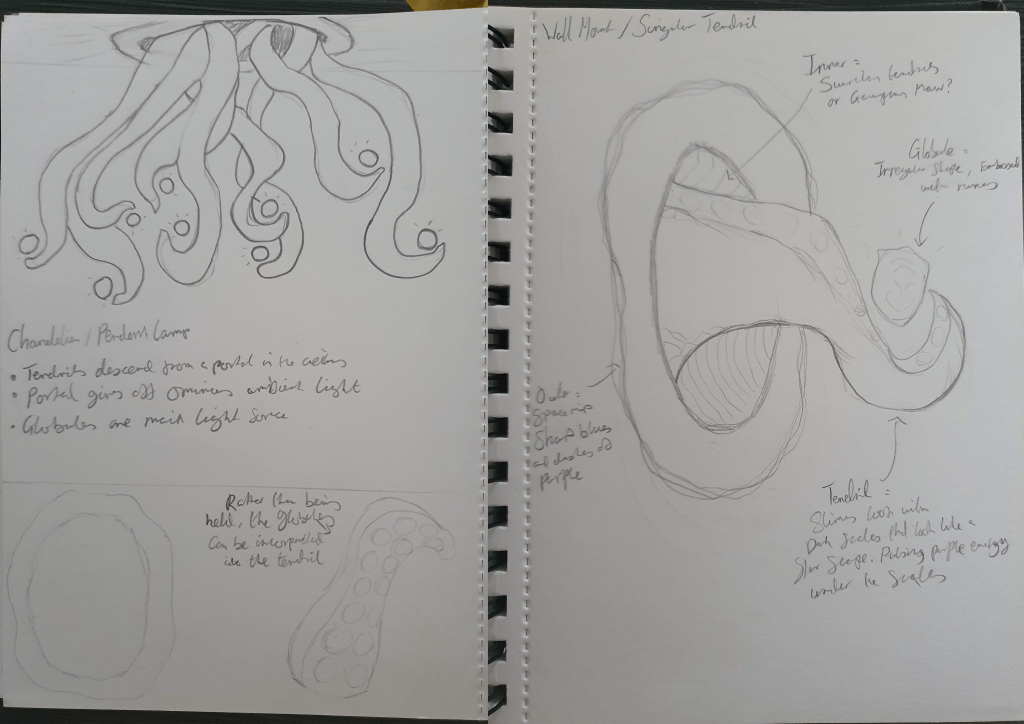
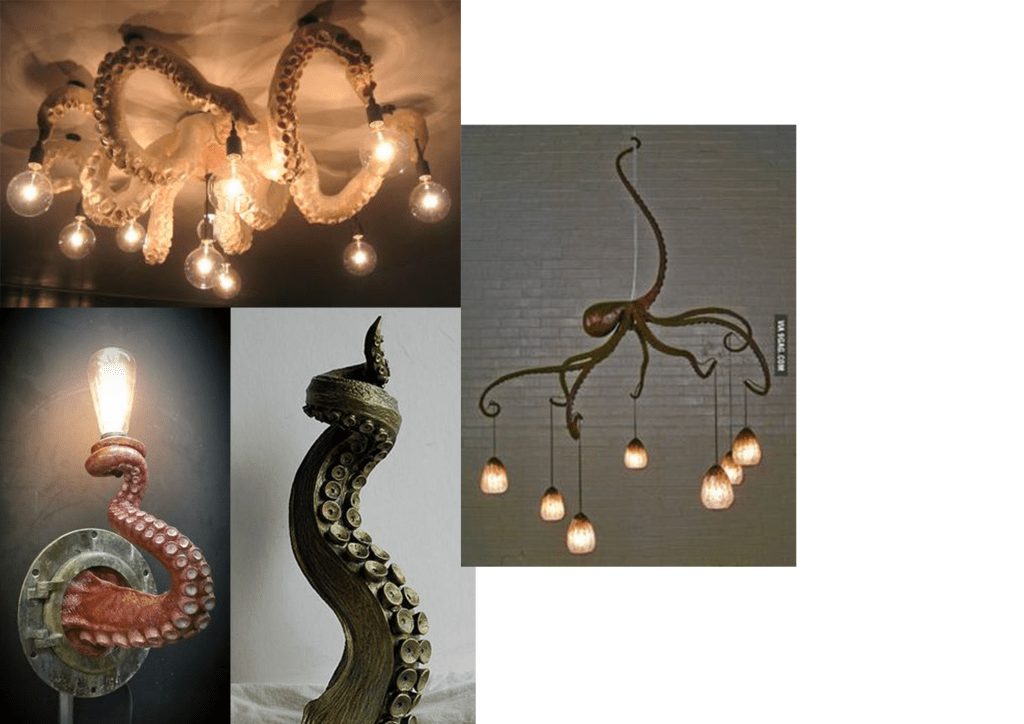
When I found myself drawn to curling forms in my initial research, my mind jumped to tendril shapes and influences of H.P. Lovecraft’s writings about otherworldly creatures and celestial forces beyond our capability of understanding. Being a fan of Lovecraftian themes in narrative, I wanted to create a light fixture based on the stories I have grown to love. The main idea I came to have was a pendant piece designed to look like a portal into deep space with dark-scaled tendrils protruding from the opening. The tendrils themselves are covered in dark purple scales with slight tints of light to look like a vast starscape and at their ends are suspended orbs of celestial light. Another form of this idea was a simplified piece where a wall-mounted pendant portal has only one tendril and orb coming out, kind of like a sconce-style design with a dark twist.
Gothic Horror Literature Concepts – Edgar Allen Poe
Another author I find that is a great influence when thinking of gothic horror literature is the great poems and tales of Edgar Allan Poe. 2 of my favourite pieces of his would-be The Fall of The House of Usher and The Raven which my ideas for lights were inspired by. The first of which is a snow-globe style set piece depicting the final act of The Fall of The House of Usher, the house split in two and sinking into the lake on the estate. The light incorporated in this piece will emanate from the lake itself as told by the story, giving off an ethereal glow-in-the-dark type effect to the piece. I would have also tweaked the glass used to contain the scene to create a stormy-style setting to fully bring the narrative together and contain the story within the globe.
The second idea I had was based on The Raven, where a dark purple raven sits upon a thorned curved branch. The bird itself will contain a light that will softly pulse, creating a violet light from within the piece. If I were to have actually made this, I would have comedically tried to contain the option of having the light occasionally cry out Nevermore at random parts of the day to cause confusion and quite possibly turn the user slightly mad.


Mask-Based Concepts – Emotion-Focused Pieces
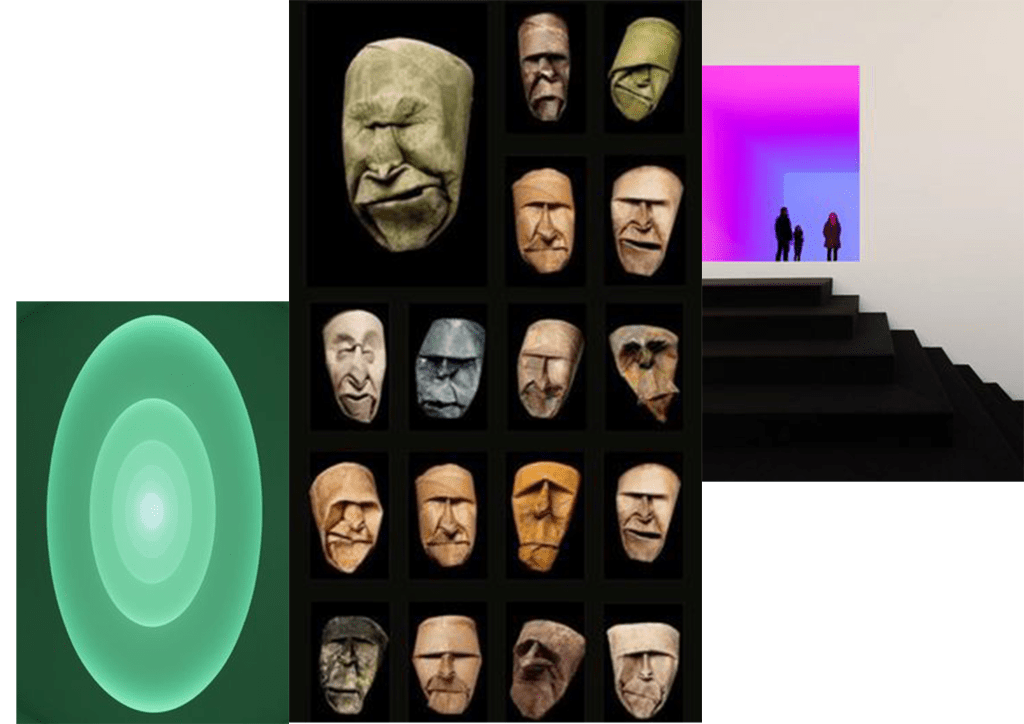
For my dissertation, I was looking into the use of narrative and how it can be used to evoke emotions in a person. The representation of emotion is normally captured in the form of masks, which is an object I have had a fascination with for a few years (my research into masks can be found here:). With my dissertation mainly focused on emotion, I wanted to see if there was a way to make a light piece that allowed for a fun way to show others how you were feeling. My concept was for a mask to be made to be placed upon a stand with LED strips tapered to the sides to provide ambient backlighting as well as for the light to protrude through the eyes and mouth. The mask itself will be a full facial mask but with the eyebrows and mouth changed into a slot for other components to be slid into. These components would be different expressional styles to allow for a full range of different expressions that, when combined with a certain colour of light, would showcase how someone would be generally feeling without having to express the emotion themselves.
A more simplified version of this concept was designed after figuring out how complex the mask could end up being while also providing a more friendly version to people with a fear of masks. This version was inspired by the works of James Turrell, an American light artist who is known for his gradient use of light to create illusory effects on several types of scales (examples shown below). My concept would be an opaque glass shape replacing the mask on the stand tapered with LED Lights to just provide an ambient background light more simply. The light used can be colours that best represent an emotion when applied to colour theory and what the colour could be interpreted as when seeing it as an emotion (e.g. Blue = Sad, Red = Angry).

Mask-Based Concepts – “The Haunted Mansion” Inspired Pieces
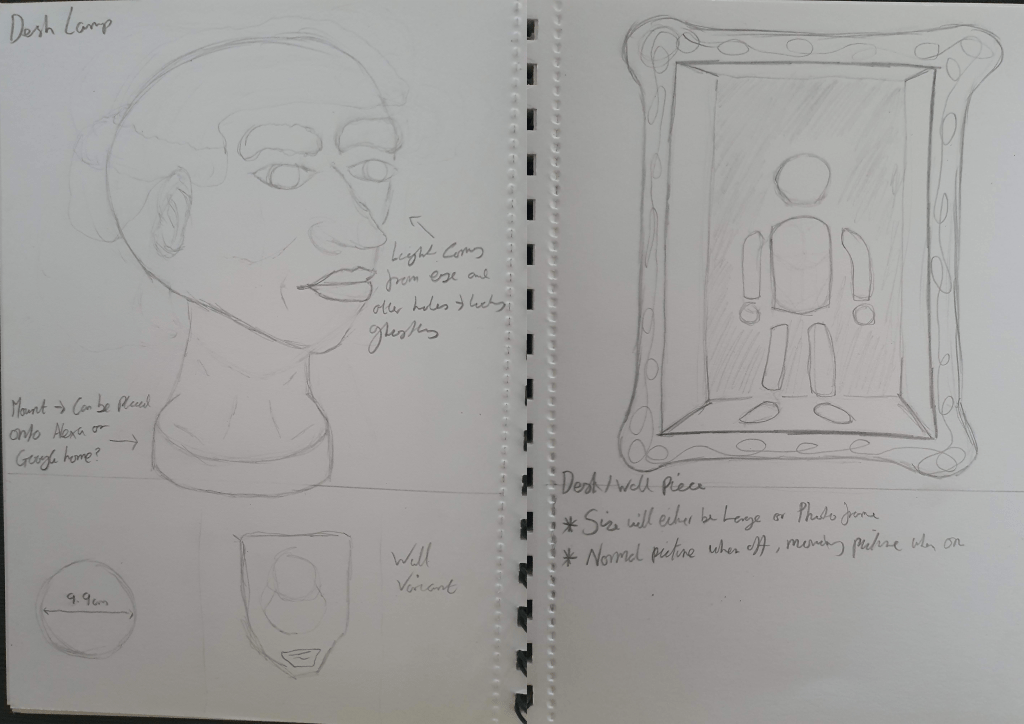
After looking into moving components and interactive pieces along with being surrounded by Halloween hype and fun gimmick-style decorations, I thought it would be fun to design concepts for light pieces that could be used in a haunted mansion setting. The first of which would be an ethereal style bust with a sarcastic personality, light softly emanating from the entire piece but brightly piercing through their eyes. The bust itself is a complicated concept that would be integrated with a home-type AI (like Google Home or Alexa), acting as a head to a bodiless voice. The piece could either act as a typical bust standing horizontally on its own or in a comedic way, could be mounted on the wall like some form of hunting trophy,
The other concept I designed was an illusion-based light fixture with the facade of a painting. The painting itself would include an old-time figure striking a pose in an enclosed space (details to be determined if I ever come back to this concept). However, with a flick of a switch, the painting would emanate an ethereal type of light and the figure within the painting would move as if it were alive. The figure would do simple things like aimlessly walk around or impatiently hum and tap their foot, as if the actual session of the model standing there while they were being painted was happening within in the painting. The scale for this piece was originally imagined as a full-scale portrait that would hang on a wall but I also love the idea of the piece being the size of a small photo frame that would be suitable for a desk.

Mask Based Concepts – Classic Horror Inspiration
Taking the influence of Halloween a little further, I wanted to try and create more horror-influenced light pieces based around masks to create more unsettling decorative light fixtures rather than just the typical lanterns and sconces. My original idea for this was to recreate a scene from the original A Nightmare on Elm Street where the FX artists stretched a length of spandex over a hole in a wall to give the illusion of Freddy Krueger attempting to push his way towards the main protagonist, Nancy Thompson. However, since I am known for taking these sorts of things to the next level, I wanted to add an extra level of terror by adding an unsettling grin and vacant eye sockets to the figure trying to press through the wall. To recreate this in my own way to become a light fixture, I would have spot-welded a wireframe for the hands and face of the figure and stretched spandex over that to give the impression of someone trying to press through the wall. The lighting used would be spotlights under the piece to allow for the shadow in the features to be over-exaggerated in the typical way people use torches under their faces when telling a scary story.
A secondary concept I also came up with that is more mask related, I took a more classic horror approach and designed a mask that personified the tale of Dr Jekyll and Mr Hyde. The mask itself would be a full facial mask but cracked into two halves, One side fearful and worried while the other would be maniacal and fearless. The features and details used would help strengthen the differences between the two halves such as facial expression, use of cracks and what kind of light is used. In regards to the light, each half would have its own light source (Jekyll would have a pure light blue and Hyde would have a vibrant crimson) that would protrude through the back and eyes while also clashing in the middle where the two halves are conjoined through the means of medical staples.


Lightbox Story Ideas – Bringing Books to Life
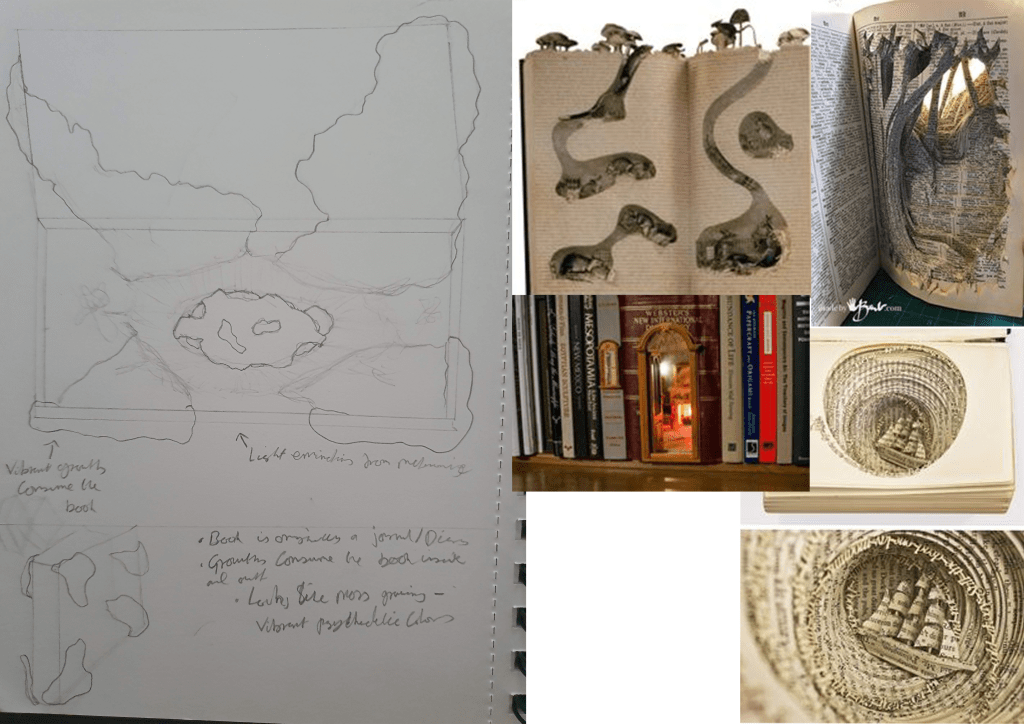
When considering how to bring a story to life through light, I came up with the idea to take a more literal approach and bring a story out of a book by creating a scene within one. To achieve this, I would have hollowed out a book and added embellishments along with LED lights to create a scene within the book. The lights inside will be triggered when open and turned off when closed so that it still contains the facade of an average book (Unless there are embellishments to the exterior of the book that add to the narrative. An example of this is illustrated below in a concept sketch which depicts a scene from the H.P. Lovecraft short story titled The Colour of Space. The book itself will have a facade of an old journal that has been lost in time, covered in ash and strange extraterrestrial growths that emanate with an odd pink glow. These growths continue to grow inside the book and originate from a crater caused by a meteorite that emanates the same pink glow.
Lighting with Jars Concept
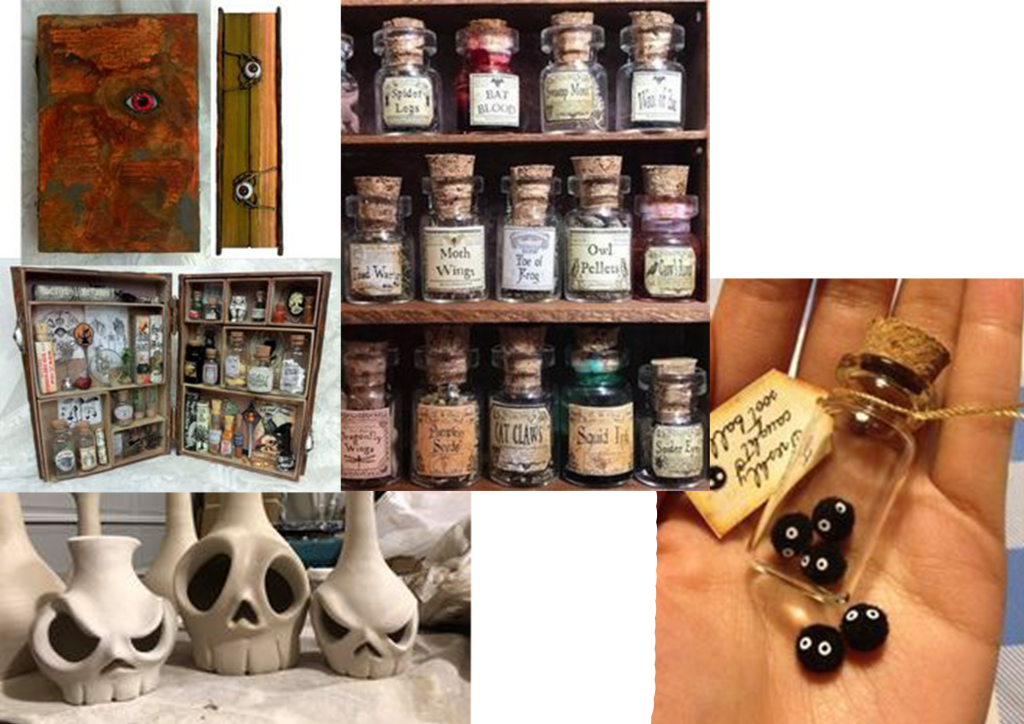
Since my magpie project, where I worked extensively with jars and the containment of materials, I never really expanded on the use of them in any project after that. They have always been a fun way to capture certain works and I wondered what kind of things I could create when trying to combine jars with lights. The concept I had was to hollow out a book into segments as if I were making a tiny portable shelf. This book would belong to a travelling alchemist, a friendly creature hoping to sell fantastical things to people in need of them most. This would allow me to create ceramic or glass jars of my own that would come in various shapes and sizes as well as create strange obscure shapes that could act as ingredients for potion making. When working at this scale, I thought it would be nice to use fairy lights as a light source but I always stumbled on how to practically use them in this setting.

Unorthodox Lighting – Layered Chandelier
When researching all types of lighting methods, I found that there were more peculiar methods of creating a light fixture than the simple ceramic or glass mediums. For example, I found a variety of pieces where the use of wood layered on top of one another could create a series of strange shapes and forms that, when light is cast through them, create fun and inventive shadows. Since I love working with multiples, I thought it would be fun to make a layered chandelier based on this concept, where square slabs will be suspended to create a flowing form for light to dangle between to create a swaying showcase of shadows.

Unorthodox Lighting – Woolen Chandelier
Another unorthodox form of lighting that I found was the use of wool in the creation of lampshades and covers. Oddly I initially found this one to be quite dangerous due to the heat given off by bulbs and how the use of wool in this way could potentially be a fire hazard. However, after research, I found that wool is naturally flame retardant and safer than other fabrics and fibres used in traditional lampshades. With this discovery, I designed a concept that takes my love of the medium of wrapping to create a twist on the Tendril Chandelier design I thought of when looking at H.P. Lovecraft-inspired pieces. By taking thick gauge wire and the cables used to light the bulbs and wrapping them in wool until they are concealed, I could use the arms as a way to suspend light while the wire I put inside can be used to adjust them into various types of shapes. After sketching out the concept, I found that it can also be looked at as a quirky floor/desk lamp if inverted (As shown below).


Lamp Based Characters
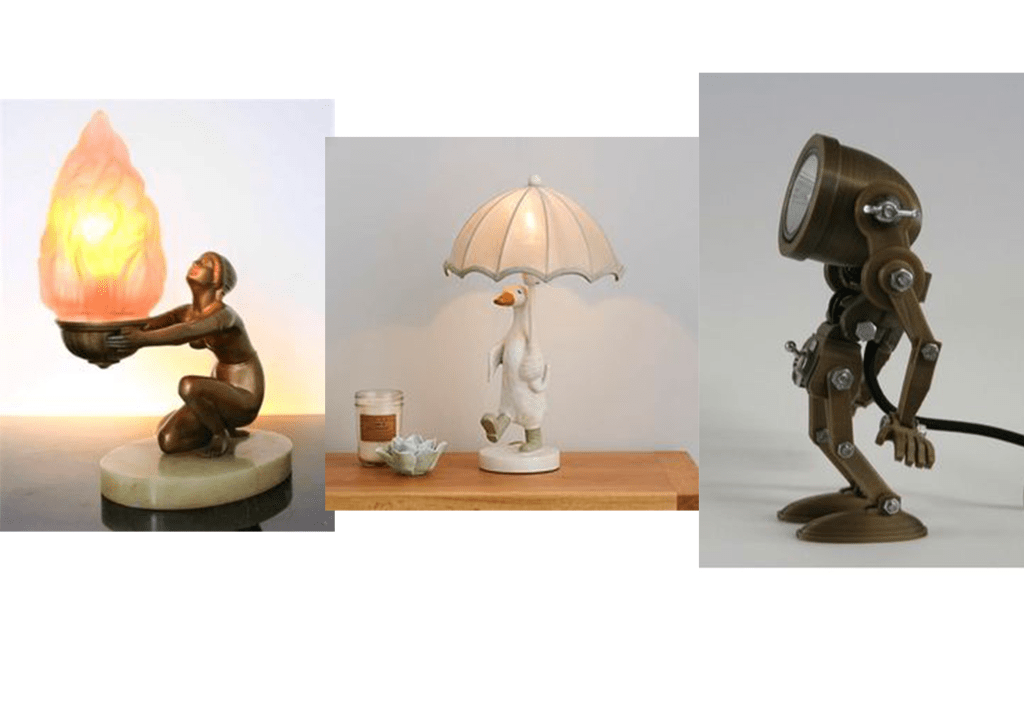
During October, I took part in Inktober where you are given a word a day and challenged to draw something every day related to the word that is assigned to that day. Since I wanted to work more creatively with my writing skills and adapt my narrative to more artistic avenues rather than concepts on paper, I set myself a personal challenge to try and create a character every day for Inktober (Examples of which can be found in my A.C.E Post or the whole collection can be found within my portfolio). Doing this challenge allowed me to open my passion for storytelling in more ways and rekindled my love of illustration, which led me to come up with a concept surrounding the story of a lamp gaining sentience and learning about the world. Whether it was an actual character made from a lamp or something that has been shown as a lamp but it is now something more. I also thought of making a Steve lamp but I knew that if I wanted to expand my horizons and look towards new techniques, I would have to try new things for a project or two (But come on, you can’t tell me he doesn’t look cute holding a little lantern?).

Then I went off the rails…
Now here is where things went a little bizarre. I had all these concepts in my head and I was breaking down all of their aspects to figure out which ones I could do and which ones I couldn’t. At this point, I thought tendril-based forms were going to be my main focus and a light fixture was going to come from that. However, one day when learning about making joints in wood, I will admit I got really bored and just stumbled upon a pot of lollipop sticks just to keep myself entertained. Don’t get me wrong, I was paying attention to what we were being taught, but it was hard to concentrate due to the use of machines and wood in general so it was easier to apply this knowledge to the lollipop sticks.
So I made a frame with them, and then another, and then another…before I knew it I was off to the shops to buy a ton of them and ended up making 100 frames that day. I got lost in the creation of multiples and I loved it. It was a new creative medium that I didn’t mind losing a day or two to, just spending hours making these small squares. After finding a new hyperfixation I wondered if there was a way to apply this to lighting and see what kind of forms and ideas I could make from this. My mind immediately went back to my unorthodox layered chandelier idea but having them suspended didn’t seem right to me. They were more fun to hold and mess around with. So after this discovery, I sadly put all my other brainstormed concepts back in the “Try for another project” draw and started on my journey to find out what kind of light fixture I could make from this craft.

Initial Work – Blocks and Springs
After making hundreds of individual frames, I wanted to see what would happen if you actually stuck the ends down together to make a shape rather than a frame. Rather than stopping at the usual 4 sticks to make a square frame, I kept going until I ran out of sticks from the bundle of 50 they were packaged in. This ended up making a solid brick-like form that was fun to hold and created layered shadows like looking through blinds. After making this discovery, I furthered my making and made a new form but rather than joining all the corners at once, I went up one corner at a time so that it would be built as one solid link with gaps. This in turn created a wooden style of spring that I could only describe as if people in the 15th Century wanted to create a slinky. This form was an extravagant thing to make and oddly therapeutic to hold and play with which I believe would be an ideal way to create an interactable lampshade of sorts.

Experimenting with Scale
After playing around with usual lollipop sticks for a while, I stumbled upon jumbo versions of them which I used to experiment with and compare to the original material I was primarily using in my making sessions. After experimenting with the jumbo lollipop sticks, I found that the materials themselves were more flimsy and breakable when compared to the original sizes. Although they did make larger shapes and forms, I decided to put the jumbo sticks aside and stick with the original size going forward into my development stages.

Experimenting with Shape
After being stuck with just a sprung square form, I went on to experiment with differently shaped sprung forms to see what kind of things I could come up with. The two varying shapes I created were a triangular formed spring as well as a form that would go in on itself and back outwards, creating an infinite collapsing shape.

Experimenting with Light
When originally using light to shine through the shapes that I made, I worked with floodlights and small LED circular lights to experiment with light strength and colour variance. I knew to avoid bulbs due to the heat they can give off so I knew it was best to stick with LED light-based sources. With this experimentation, I found that floodlights provided a strong light source but only in a singular direction whereas the LED circular lights provided different colours, they were too small to fully light up the whole form and were very troublesome to stack on top of each other to be able to actually fully light up the shape. This led me to try and figure out a way to try and make a light that has the same shape as floodlights, can shine light in a 360-degree manner and can shift colours like circular lights.
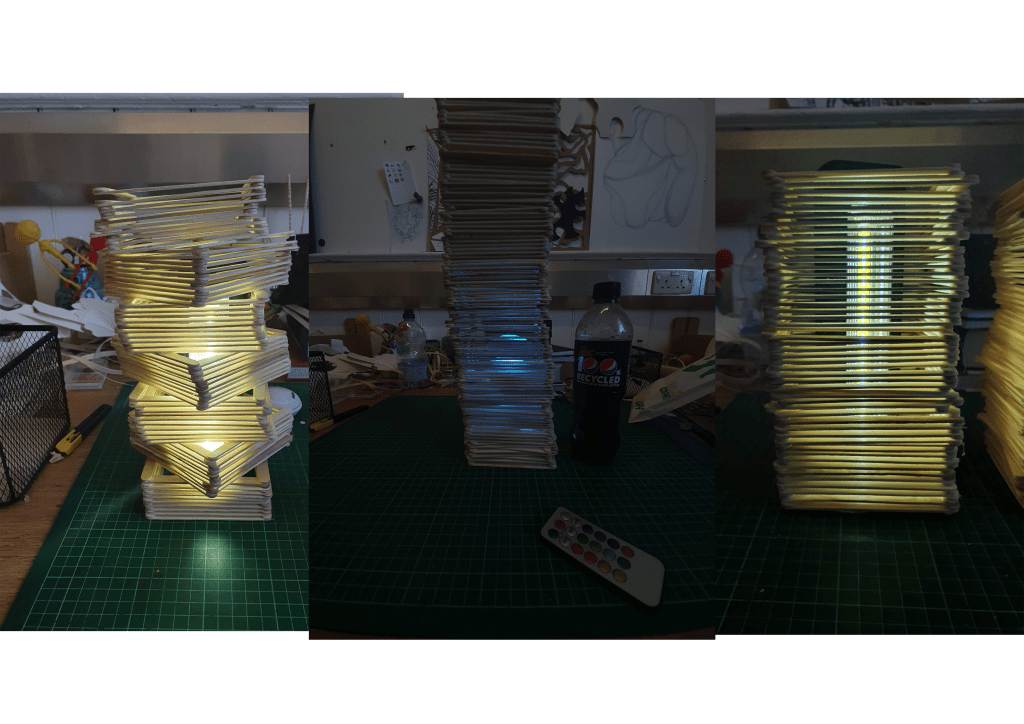
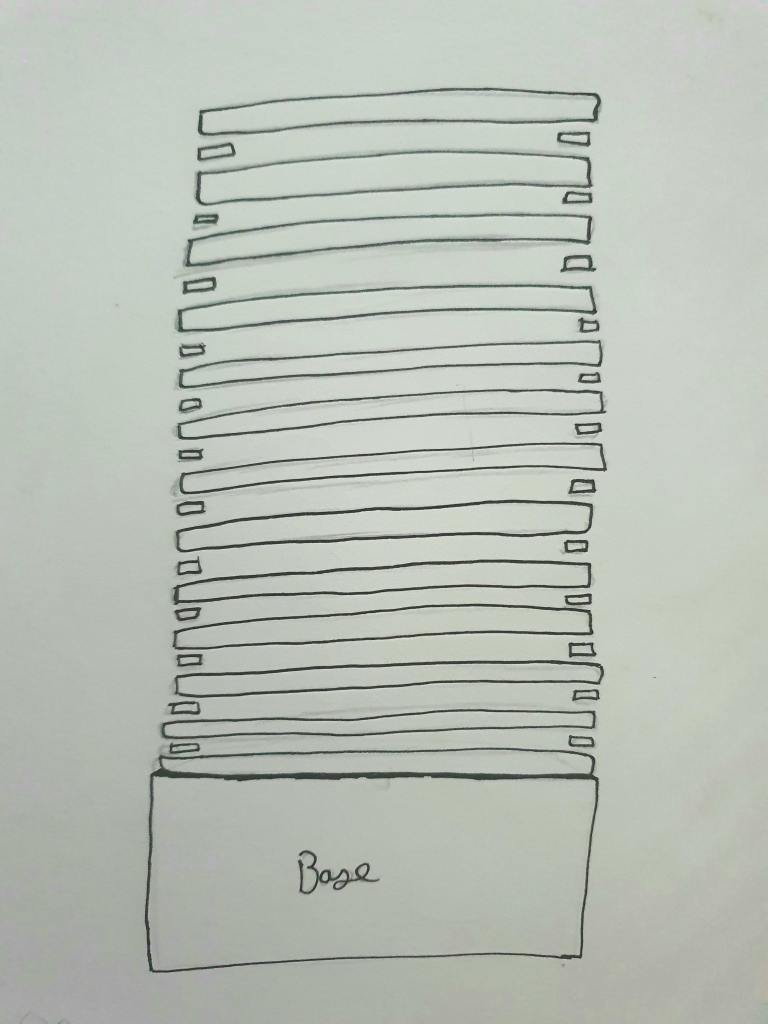
Final Piece Designs
For my final piece, I wanted to make an intractable light fixture where the user can play around and use the shade but also use it as a decorative piece if they so wish. The shade surrounding the light acts as a slinky-type form and can be picked up from the base to be held and played with. Due to the form being made of wood, it can be quite delicate so the use of play in this sense is more of a gentle therapeutic definition rather than forcefully testing its limits like most things people handle when stressed. In regards to how the shape can be lit, I have designed a way of joining LED strips together to create an LED wand that should shine light in 360 degrees and also gain the ability to adjust the colour rather than the typical light you get from bulbs.

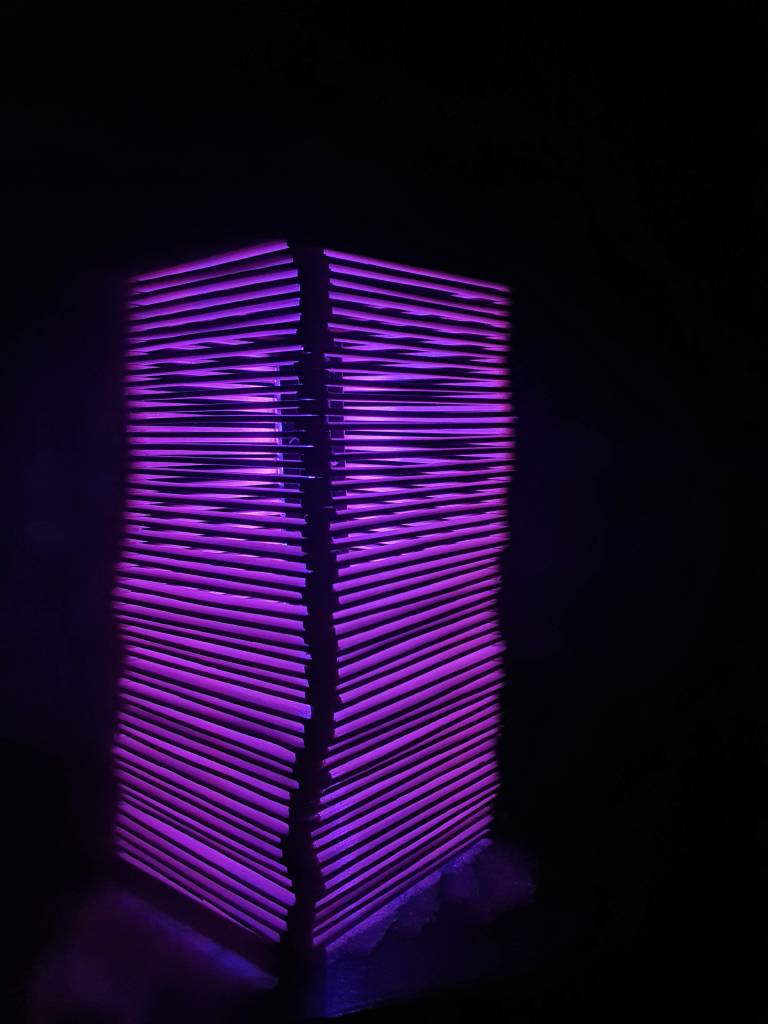
Final Piece
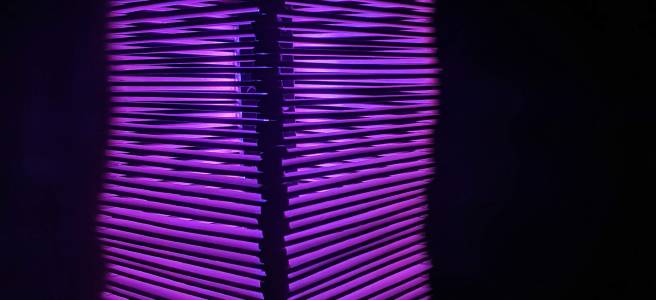
When fully constructed, this is how the final piece came out. I am honestly so proud of how it turned out as it came out a lot better than I originally designed. The design of the LED wand worked wonders and was able to fully light up the shape without any gaps. If I were to make any additions to this piece, I would have created a stand that would hold everything into place rather than the lights and all of its components stored inside of a box that the shape itself sits on.


 Samuel Mathias