- Introduction
- The Curation Space
- Frontal Lobe – Academic Background & Problem Solving
- Parietal Lobe – Triggers and Repeating Tasks
- Temporal Lobe – Musical & Emotional Understanding
- Occipital Lobe – Visual Processing + Perception
- Conclusion
- Bibliography
- List of Illustrations
Introduction
“The one thing that you have that nobody else has is you. Your voice, your mind, your story, your vision.” (Gaiman, 2012). These words from Neil Gaiman stand out to me as throughout my life I have had people telling me what is good and what is bad, what I should learn and what I should not. It was only through these recent years of independence that have allowed me to be my own person and make my own decisions based on my mind and vision. However, I still have a lot to learn about myself and a lot to teach others about me and how I work. That is what I want to do for my curation. To delve deep into my mind and allow others insight into how my mind works and help me learn more about myself in the process. To do this, I am going to create a curation within my brain that is sectioned off based on the lobes themselves. Each lobe will be curated differently and will each contain information significant to that part of the brain, showcasing attributes that make me the artist I am today and what has influenced me to become the person I have become and will continue to be.
The Curation Space
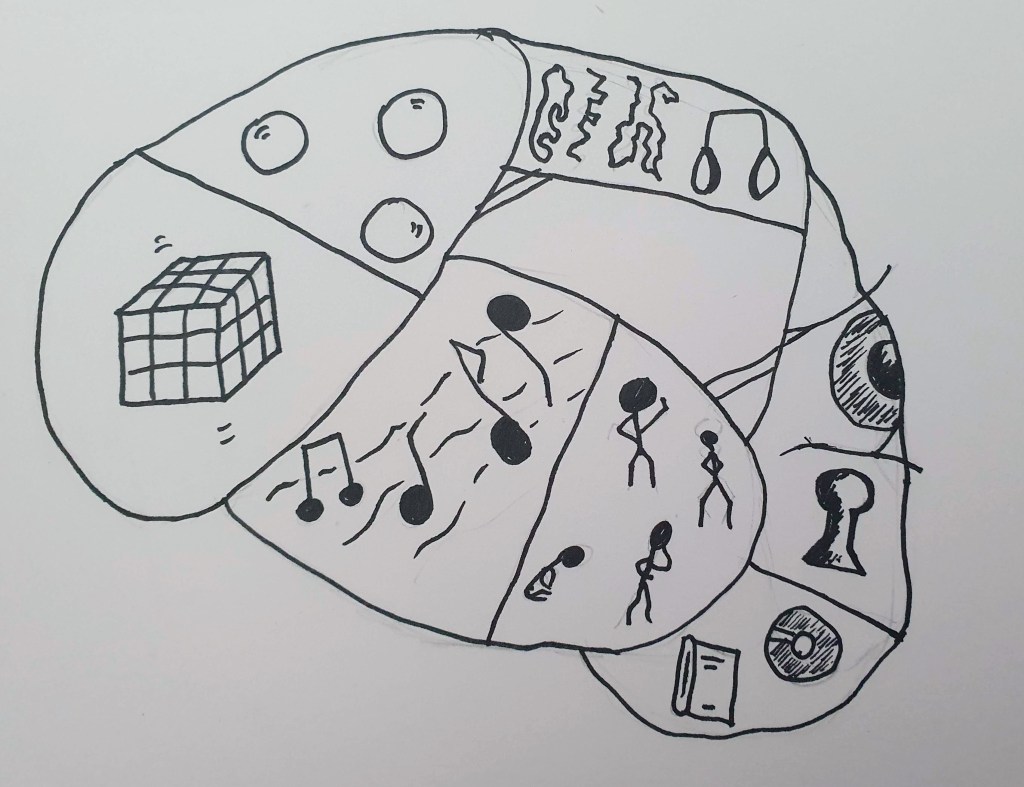
To show how the curation space itself will be laid out, I have designed an illustrative map of a brain, splitting the lobes into sections. Each section will showcase a certain attribute specific to that lobe of the brain where it is significant. As Richard Fortey once said “A life accumulates a collection: of people, work and perplexities. We are all our own curators.” (Fortey, 2008) and hopefully, through my curation, I can show my life so far as a collection.
Frontal Lobe – Academic Background & Problem Solving
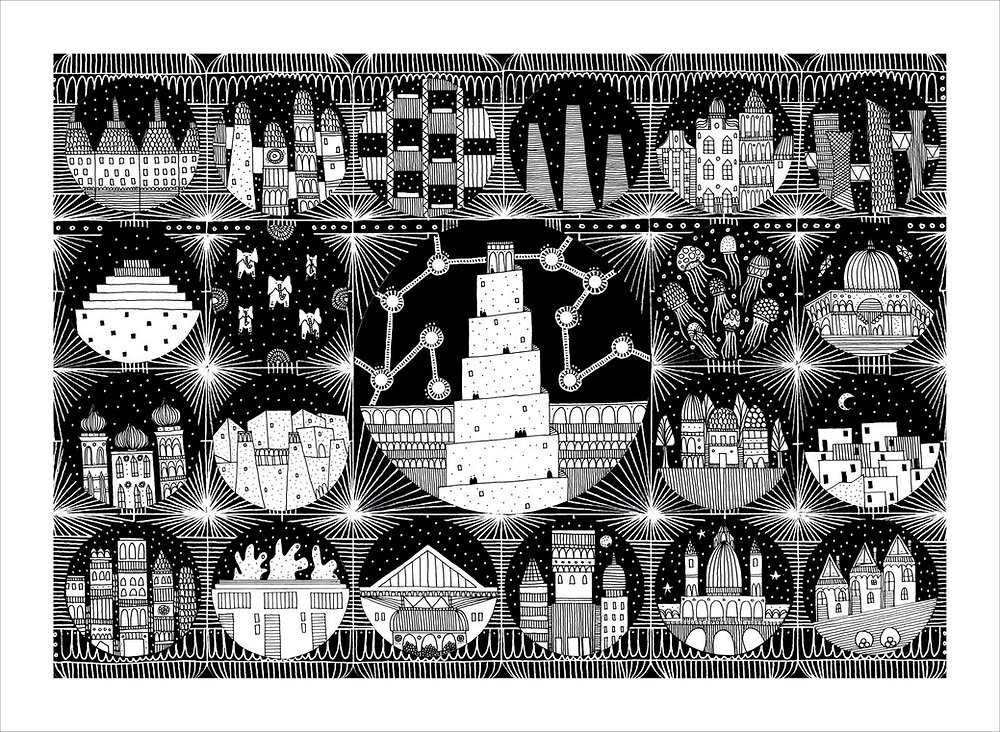
Growing up with autism has allowed certain attributes of my brain to be stronger than others. This has caused a lot of confusion towards what I should do for the future going through education as I was never sure what career choice would be the best for me. For this reason, a part of my exhibition will be set around showcasing possible career paths captured in crystal balls like snow globes. My inspiration for this showcase is from Fedora, A city from Invisible Cities by Italo Calvino, where depictions of alternate versions of the same city are encased within glass globes for visitors to admire, what the city could be if something went differently.
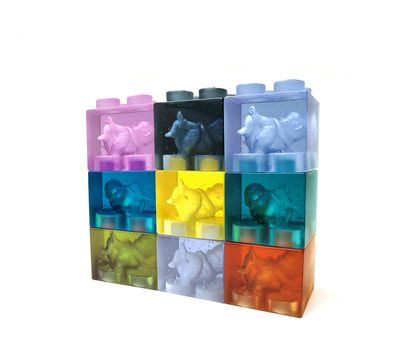
A skill that has stuck with me and has been one of my strongest since I was young is problem-solving. I have always had a love for puzzles and it has allowed me to be more inventive with the way I think about my creative projects. To showcase this within my curation, I take inspiration from a piece within the “Revealing the Invisible” collection created by Namdoo Kim (2017). The piece itself is titled “Expendable being” and depicts babies encased within colourful glass Lego blocks and has allowed me to come up with the idea to encase puzzles and other problem-solving methods that I have grown to love within colourful cubes of their own. These cubes will then combine to create a large Rubik’s cube so that the puzzling pieces themselves will become a large-scale interactable puzzle.
Parietal Lobe – Triggers and Repeating Tasks
One of the downsides of growing up with autism is hypersensitivity with certain senses. Ranging from tasting textures, feeling vibrations through materials and even experiencing high-pitch frequencies, being exposed to what I am uniquely hypersensitive to can have negative effects which lead to me shutting down mentally if exposed to large amounts at a time. I plan to showcase this within my curation as The Room of Triggering Textures and Frustrating Frequencies. This room will be wall-to-wall covered in various textures, as well as headphones accessible that will play frequencies and tones, that I am hypersensitive to so that audience members will begin to feel what a shutdown feels like. When you are surrounded by unsettling environments that others might find normal, you slowly become claustrophobic and feel yourself reject everything coming into your brain making you feel helpless and unsure of what to do to get back to a considered “normal” way of thinking and acting to the world.
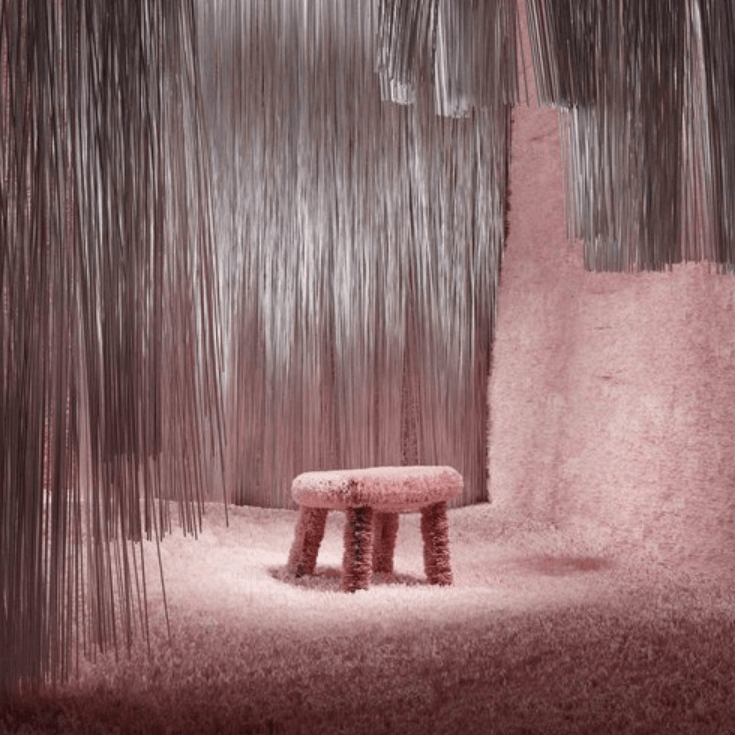
Thankfully, after suffering through many shutdowns in my life I have found ways to destress and bring myself back from dark places. These tasks normally do not require much brain power so it allows me to relax and for my brain to not be strained when recovering. They also tend to be tasks that repeat themselves over and over again, having a hypnotic effect which is what I believe to be the most beneficial factor due to it being a distraction from whatever caused me to shut down in the first place. I want to showcase this within my curation as an escape from the previous room of triggers and frequencies so that audiences who experience it can recuperate and become stable before continuing. The room will show a series of tasks repeating themselves over and over through mirrors, allowing audiences to experience the same hypnotic effect combined with soothing tones to help relaxation at maximum efficiency.

Temporal Lobe – Musical & Emotional Understanding
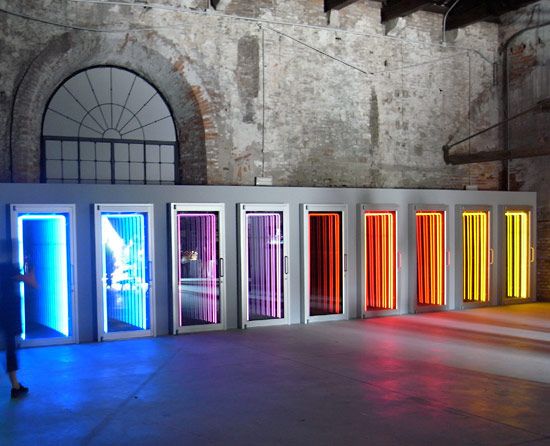
As spoken by Edward Bulwer-Lytton somewhere between 1803-1873, “Music, once admitted to the soul, becomes a sort of spirit, and never dies.” (Bulwer-Lytton, 1803-1873). Music has always been an integral part of how I go about my routine. It helps fill the gaps of silence and has been a part of me throughout my life. I chose this quote as it resembles how music itself is its own force and it is something that affects all of us in different ways. For that reason, I want to showcase how certain music types make me respond whenever I listen to them. I take influence from an illuminating piece in the Chilean pavilion titled “Death Row”, which consisted of small capsules with neon illuminated doors which when inside create an optical illusion. I want to use this influence to create capsules of my own, each representing a different genre of music and having different stimuli to recreate my responses to its allocated genre.
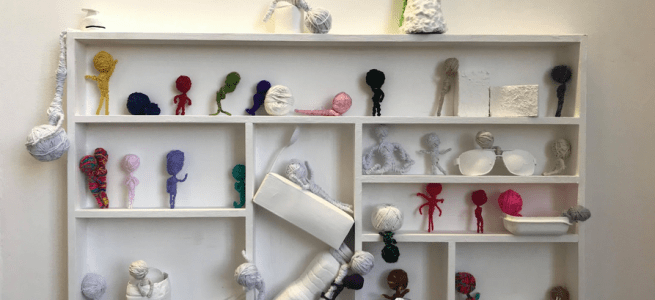
Along with music, emotions have been a significant influence throughout my life and, in most recent years, my work. Growing up with autism has had its ups and downs, one of the downs being the fact that understanding emotions can be tricky. Both with myself and viewing others, it is hard to determine how exactly someone is feeling and even more so to explain how you are feeling to others. By having a creative outlet, I have been able to expand on my understanding of emotion and have based a lot of my creative works around it as, in my opinion, it is an interesting topic to work around. This is why within my showcase of emotion, I take influence from myself and my previous project on emotion where I took characterisations of emotions themselves and brought them to life in the form of small string effigies that stood together united, on a shelf, for everyone to witness emotions in their purest forms in easily distinguishable ways.

Occipital Lobe – Visual Processing + Perception
When your senses are hypersensitive, you tend to take a lot more into your brain than the average person. Growing up this was always the case whenever I read books or watched movies and is still the case in the present day. Narrative-based works have always been influential to me and my process as I have always felt a stronger link to them than to any other art medium. This is why this exhibit will be a curation in itself, showcasing all the influential artists that I have grown up with and who have helped me become the creative I am today. This will be curated much like a library, where authors, like Darren Shan and Neil Gaiman, whose books I endlessly reference will be showcased alongside viewings of movies made by influential movie makers, such as Tim Burton and Ridley Scott so that it welcomes audiences preferences to books or movies.

With a hypersensitive sense of sight comes a heightened sense of perception. Studies have shown that “Individuals with autism spectrum disorder (ASD) often display impairments in creativity, yet savant artists with ASD are reported to produce highly novel and original artistic outputs” (Pring, 2012, p. 45-57). My perception of the world around me has allowed this study to carry further meaning since the process by which my creative outputs are created is so eccentric and mind-boggling that it tends to confuse even my own tutors. This showcase is where I would say my desk would be if I were to live within my brain as all of my creative projects are based on my perception. Therefore, as this is my private study it will be closed off to the public, locked behind an old oak door with a large keyhole for them to peek and listen through if they so wish, hearing the fantastical sounds and catching glimpses of my current and future works.

Conclusion
In conclusion, the way my mind works is unique as every mind works differently in its own unique way. It is the explanation of a person’s vision that helps people understand how exactly their mind works and in regards to how much they disclose about their vision is up to them. Some like to reveal all and others like to keep it all secret. It is those visions that help make us unique as individuals and I hope to use my vision to remain unique and not conform to what others want me to be. Like Tim Burton once wrote, “Visions are worth fighting for. Why spend your life making someone else’s dreams?” (Ed Wood, 1994). I would like to think this journey has led you to a greater understanding of my ways of perceiving.
Bibliography
Bulwer-Lytton, E (2020) Edward Bulwer-Lytton > Quotes > Quotable Quote. Available at: https://www.goodreads.com/quotes/99561-music-once-admitted-to-the-soul-becomes-a-sort-of (Accessed: 22nd April 2020).
Burger, J (1972) Ways of Seeing. Middlesex: Penguin Books Limited
Calvino, I. (1974) Invisible Cities. Great Britain: Secker & Warburg.
Ed Wood (1994) Directed by Tim Burton [Film] USA: Buena Vista Pictures.
Fortey, R. (2008) Dry Store Room No. 1: The Secret Life of the Natural History Museum. New York: Harper Press.
Gaiman, N. (2012) Commencement Address to Philadelphia’s University of the Arts, 17 May.
Pring, L. Ryder, N. Crane, L. (2012) ‘Creativity in savant artists with autism’, Autism, 16(1), pp. 45-57. DOI: 10.1177/1362361311403783.
List of Illustrations
Figure 1: Mathias, S (2020) Self Reflection Curation – Map
Figure 2: Bari, O (2017) Three Principles of Architecture as Revealed by Italo Calvino’s ‘Invisible Cities’. Available at: https://www.archdaily.com/875409/three-principles-of-architecture-as-revealed-by-italo-calvinos-invisible-cities (Accessed: 24th April 2020).
Figure 3: Kim, N (2017) Expendable being. Available at: http://www.namdookim.com/expendable-being.html (Accessed: 24th April 2020).
Figure 4: You Wanted a List (2019) Andrés Reisinger. Available at: https://www.youwantedalist.com/blog/andres-reisinger (Accessed: 25th April 2020).
Figure 5: Mason, B (2017) Why is Yayoi Kusama’s Artwork Tapping into the Zeitgeist? Available at: https://www.architecturaldigest.com/story/yayoi-kusama-zeitgeist?mbid=social_pp_facebook_dezeen (Accessed: 25th April 2020).
Figure 6: Designboom (2009) Ivan Navarro: Chilean pavilion Venice art biennale 09. Available at: https://www.designboom.com/art/ivan-navarro-chilean-pavilion-venice-art-biennale-09/ (Accessed: 25th April 2020).
Figure 7: Mathias, S. (2019) Tabula Rasa [Installation]. Alex Building, Swansea. (Viewed: 14th May 2019)
Figure 8: Johnson, A (2017) Starfield Library. Available at: https://www.onthebookshelf.co.uk/2017/06/starfield-library.html (Accessed: 26th April 2020).
Figure 9: Harrison, R (2009) Through The Keyhole. Available at: https://www.flickr.com/photos/sovietuk/3264671944/ (Accessed: 26th April 2020).

 Samuel Mathias