Introduction
Within this essay, I will use two examples of digital media that have heavy visuals consisting of masks and how their use within these mediums can be expressed as the removal and cancellation of emotion from their core elements and then replaced with a non-changing, neutral state of expression. The two examples of digital media I will use shall be analysed and compared with each other to find similarities and differences in their use of masks as well as links to my current project regarding Tabula Rasa and how masks themselves can be perceived as a way to make your true face a blank slate and be seen by others as something completely different.
Eyes without a face – Jean Redon
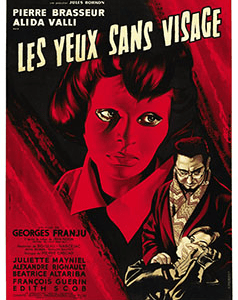
The first example of media I shall investigate is a French film adaption of Jean Redon’s novel Les Yeux sans Visage. Jean Redon is a French writer, screenwriter and dialogist who is mainly known for his novel Les Yeux sans Visage. Other works created by Redon, such as Fernand Cowboy and The Beast is Released, are lesser known which caused information on him to become limited and hard to locate. The adaptation of Redon’s novel has been known under many titles but the ones most commonly known to the Western world are Eyes Without a Face to non-french speaking Europeans and The Horror Chamber of Dr.Faustus to Americans.

Eyes Without a Face is classed as a psychological thriller-style Horror film created and set in 1960s France. The film itself follows a plastic surgeon Dr Génssier and his dark medical efforts in the hope of reclaiming his daughter’s face. This obsession of his started after being overwhelmingly struck by guilt after causing an auto crash which led to the disfigurement of the face of his daughter, Christiane. This causes her to constantly wear a mask bearing a fully constructed face with a neutral expression. After faking the death of his daughter, he begins his attempts to fix his daughter’s face by performing surgery of his own creation known as Heterograft, which he uses the help of his assistant Louise to track and lure helpless victims to his private medical facility to donate their face without their own consent. However, the procedure itself hasn’t had much success which has led to a pile-up of victims as well as a missing person case being created by the local police force. Christiane begins to hate how she is living and how to save her disfigurement, she allows her father to test on helpless victims and animals he keeps caged up in his lab. As an act of insubordination, she helps a young woman escape the clutches of Louise in which a fight breaks out leading to Louise’s demise. During this escape attempt, Dr Génssier returns after removing suspicion that the police have built upon him to be welcomed by a pack of angry dogs and birds, set loose by Christiane, that seek vengeance on the man who tortured and caged them up for science which leads to the mutilation and death of Génssier and an open opportunity for Christiane to leave with peace and never look back.

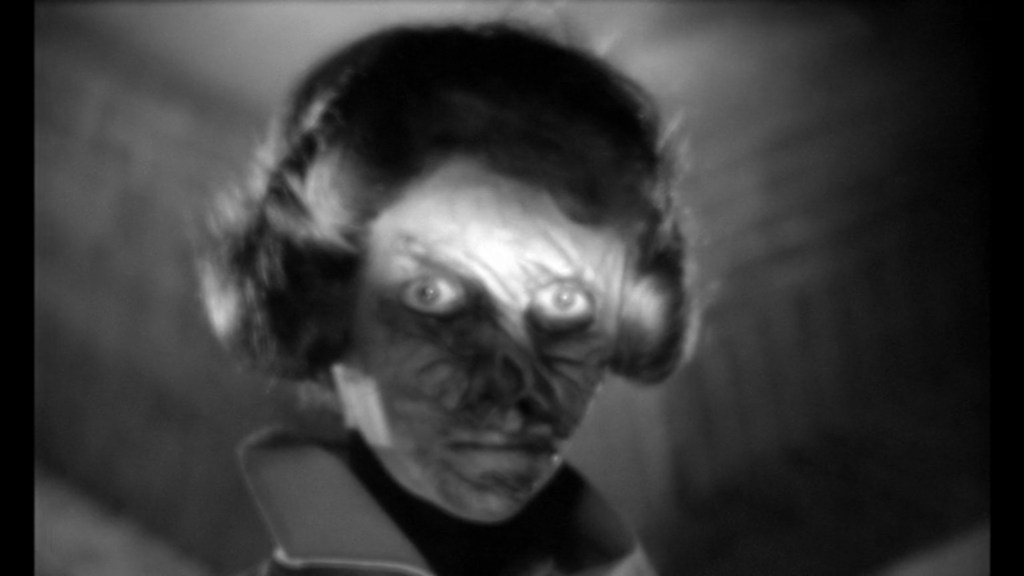
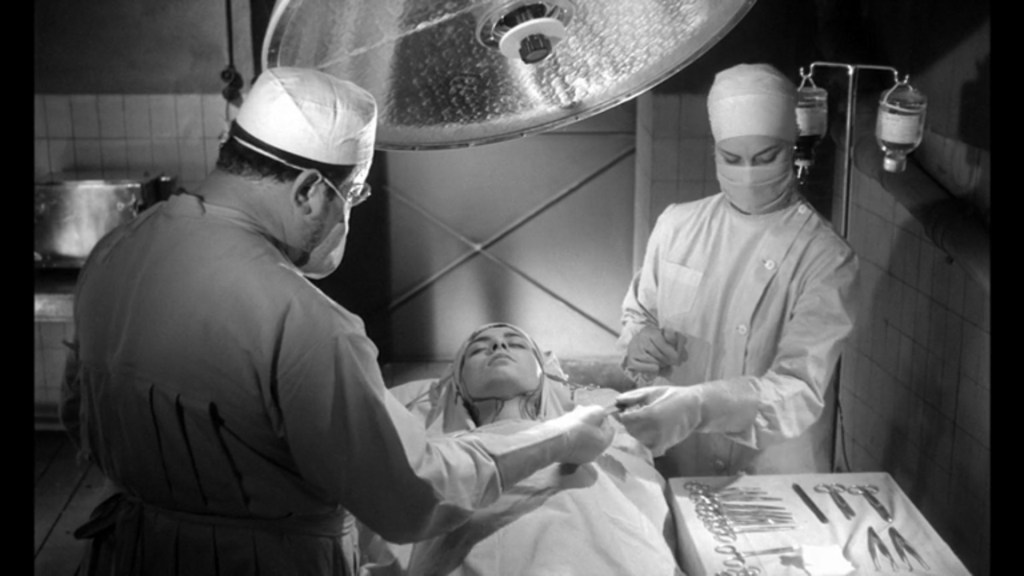

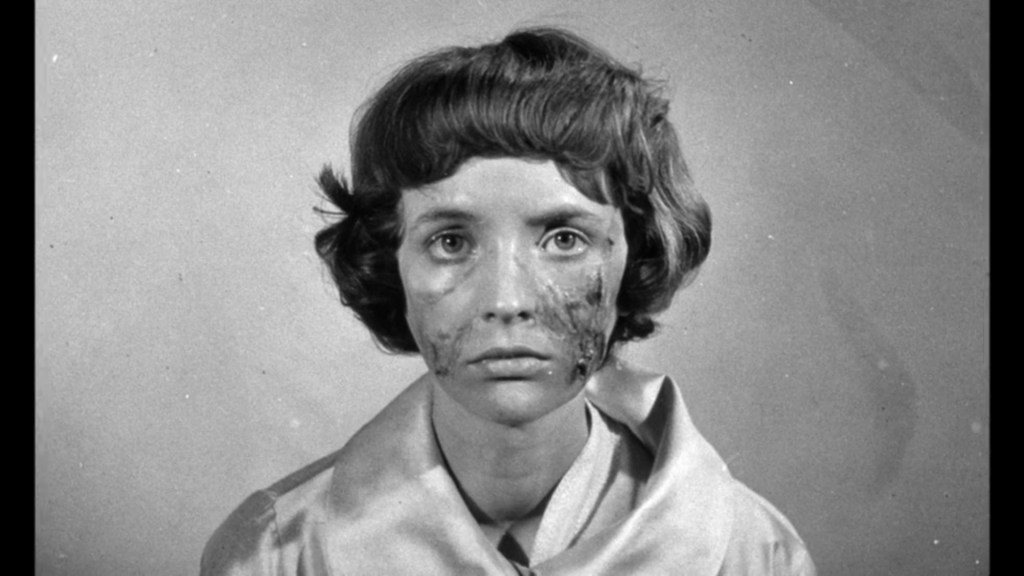
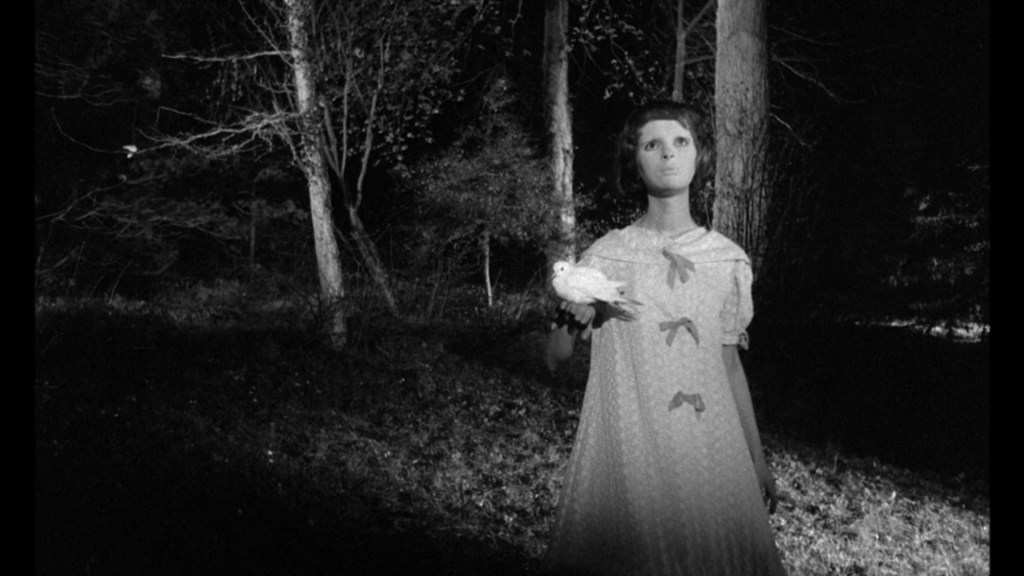
When it comes to discussing Eyes Without a Face as a whole, I was astounded at the fact it was created in the 1960s due to the fact it feels far ahead of its time. With its graphic scenes, ominous sound design and spine-chilling body movement and atmosphere, this film launches you into an uneasy sense of security right off the bat and continues to do so throughout the experience. In regards to Tabula Rasa, the use of masks in this film allows the character, Christiane, to retain a neutral state of expression throughout its entirety. This caused her to express herself through variance in vocal tones and body language which gave her character a more eerie edge to her personality which added to the tension created within the film. The void of expression and emotion within this context allowed me to visualise the emotions of the characters in different ways which allowed sparks and ideas for my project to come to existence.
We Happy Few – Compulsion games
The second example of media I Investigated was a survival action/adventure game titled We Happy Few developed by a studio by the name of Compulsion Games. Compulsion Games is a small video game company based in Montréal, Canada. Founded in 2009, Compulsion games have only produced two games but both have been beautifully animated and created in different styles as well as both having compelling and interesting storylines that keep you hooked and want to play more.

We Happy Few is a survival action/adventure style game with horror/puzzle elements that is set in 1960’s dystopian Britain. In this dystopia, Happiness is a forced choice as the people of Wellington Wells constantly take a drug called Joy that keeps them happy and denies them any other emotions or memories of the past that can trigger those emotions such as World War 2. However, if you do not take this drug you are considered a “downer” who is considered an outcast and if found in the wrong part of town, the police and other townspeople on Joy will feel the need to get rid of you. The story of We Happy Few follows 3 unique characters trying to escape from the town to a place where happiness isn’t something you have to take a pill to get. This cast consists of Arthur Hastings (A redactor for the local newspaper who is in desperate need to reunite with his lost brother, Percy), Sally Boyle (The “It” girl of Wellington Wells who supplies the rich and powerful with potent concoctions with her brilliant chemistry skills) and Ollie Starkey (A mad Scotsman who has the capability of revealing the truth behind a sinister plot developing within Wellington Wells). These characters intertwine and collide throughout their stories and help each other figure out their potential and their abilities when it comes to figuring out how to escape.


When it comes to discussing We Happy Few, its experience as a whole was fun, imaginative and creative in every respect. The use of vibrant colours, 60’s aesthetic styles and English Architecture perfectly contrast with the depressive tones of remembrance, twisted sinister storylines and the use of accents and variance in body language to allow every single character to have their own personality. There are also countless opportunities when it comes to replayability due to large quantities of quests as well as streaming platforms showing others playing the game as well as having the ability to witness others’ experiences. In regards to how it ties into Tabula Rasa, the game uses masks on the townspeople, police and doctors, within heavily Joy-enforced zones, that give them large sinister smiles. This allows those characters to appear constantly happy even though they may not be. This is also contrasted by the fact that in people in more “Downer” populated areas, masks aren’t seen at all, symbolising freedom of expression and the constraint of constant drug use to be happy. The use and symbolism of the masks within this context helped to bring certain ideas into the light for my project and helped me consider their use in other mediums and contexts.
Comparison of Eyes Without a Face & We Happy Few
When it comes to comparing Eyes Without a Face and We Happy Few, the main factors that spring to mind are their stories, their similarities and differences, and their similar links to Tabula Rasa. Regarding their stories, both are set within the same period of 1960s Europe as you can tell by the similarities in architecture, music choices and fashion styles you see throughout the two works. The stories themselves do vary after that main comparison as one is based on a mad doctor overstruck by grief and the other is based on 3 ragtag individuals in need to escape a drug-addicted society.
Although in both stories, there is a similarity regarding doctors abducting people to conduct experiments for reasons related to furthering scientific medicinal research even though Eyes Without a Face uses a more selfish viewpoint than that of the viewpoint of We Happy Few. The main difference between the two works is the use of colour between them. Eyes Without a Face is void of colour which allows a more horrific tone whereas We Happy Few changes the use of vibrancy of colours to the dullness and sickly tones it can create depending on if a character is influenced by Joy.
Regarding how these two works contribute to Tabula Rasa, the use of masks allowed characters within these stories to carry a constant state of expression and emotion whether it was blank and desolate or overjoyed and sinister. This void of expression was also relevant to characters without masks, such as Dr Génssier who tends to not show any facial expression throughout the movie but has the advantage of facial features to show in other ways how he reacts to certain situations. From an aspect of storytelling, masks forced viewers to visualise how characters were feeling in other ways with the help of their vocal tones and body language.
Conclusion
In conclusion, the use of masks in storytelling can be effectively used to remove expression and emotion from a character and allow the audience to visualise these aspects in their own unique way. In regards to masks being a form of Tabula Rasa, the evidence found within this essay can be used to further solidify the fact that they can be used for this fact and how their use helps add certain atmospheres and tones to a character/world depending on their usage. Due to these findings, I want to use the visualisation of emotions and expressions to influence my work within this project as analysing emotions and visualising them in my own way is something I do daily and I think will greatly strengthen my work.
Bibliography
The subjects within this bibliography have been titles and websites I have read and researched from the start date of my project to the completion date of this essay. Not all the titles themselves have been incorporated within the essay but their uses have helped influence ideas and topics based around the project and also this essay.
- Banas, A. (2007) Eyes Without a Face.https://en.wikipedia.org/wiki/Eyes_Without_a_Face
- Calvino, I. (1974) Invisible Cities. London: Secker & Warburg
- Compulsion Games (2009) Compulsion Games Official Website. Montreal https://compulsiongames.com/en/
- Compulsion Games (2016) “We Happy Few” Official Website. Montreal http://www.wehappyfewgame.com/#about
- Dubost, K. (2011) Jean Redon. https://fr.wikipedia.org/wiki/Jean_Redon
- IMDB (Date of creation unknown) Eyes without a face. https://www.imdb.com/title/tt0053459/
- Ingold, T. Matsutani, T. Sehgal, T. Grosse, K. Tim Ingold’s thinking through making. http://www.louisapenfold.com/4552/
- Jones, A. (2012) Seeing Differently: A history and theory of identification and the visual arts. Oxon: Routledge
- Kelly, M (2018) The Science behind the ‘Call Of The Void’. https://www.wbur.org/endlessthread/2018/06/29/the-call-of-the-void
- Locke, J. (2014) An Essay Concerning Human Understanding. Hertfordshire: Wordsworth Editions Limited
- Mollon, P. (2000) Ideas in Psychoanalysis: The Unconscious. Cambridge: Icon Books UK
- Rogers, G.A.J. Locke’s Philosophy: Content and Context. Oxford: Clarendon Press.
- Roth, P. (2001) Ideas in Psychoanalysis: The Superego. Cambridge: Icon Books UK
- Segal, J. (2000) Ideas in Psychoanalysis: Phantasy. Cambridge: Icon Books UK
- Terada, R. (2001) Feeling in Theory: Emotion after the “Death of the Subject”. USA: Harvard University Press.
- Woodfield-White, J. (N/A) Horror Sub Genres. Blog. https://asmediawoodfieldwhite.weebly.com/horror-sub-genres.html

 Samuel Mathias